Zero-shot homogeneous LLM teams are baselined against a trained MARL reference policy.
Open-ended multi-agent coordination benchmark
Alem
Can LLM agents coordinate in long-horizon, open-ended tasks?
Alem is a JAX benchmark for testing multi-agent coordination in long-horizon, procedurally generated open-ended worlds. Across nine levels with controllable coordination demands, agents must explore, communicate, trade resources, craft tools, build structures, and fight mobs. Alem supports LLMs, VLMs, RL agents, and human play.
Finding 1On Hard difficulty, a zero-shot frontier LLM approaches our 1B-step MARL baseline.
Finding 2Coordination is a distinct axis of difficulty, separate from base-task skill.
Finding 3Communication has the largest impact on coordination in our harness ablations.
01 · Leaderboard
Model leaderboard
Coordination reward is reported independently from base reward and total return.
18.8% Coord.% on Hard difficulty, the first open-weight model to lead this metric. It edges our 1B-step MARL baseline (17.6%), though the intervals overlap and the interface differs.
| # | Model | Type / date | Harness | Alem | Base% | Coord.% | Total% |
|---|
Click any LLM score for the run config and how-to-run command. Bars show 95% bootstrap confidence intervals; dots show means. Type / date reports the selected difficulty's evaluation date; Harness links to the evaluation harness implementation; Alem is the environment version the row was evaluated on. The only environment change between 0.1 and 0.2 is a fix to a rare ladder-generation collision that could block one of the three ladders on a level; levels that did not collide are bit-identical, and comparing results across the two versions found no statistically significant difference in performance. Base%, Coord.% and Total% are normalised separately, so Total% is not the sum of the other columns. MARL 100M / 1B / 10B are environment training steps, not model parameters. On Hard, switch on Mixed teams to add mixed-model teams (marked mix) to the table unranked; click one for the member breakdown. Submit a result →
Reference point · MARL baselines
Trained multi-agent RL provides a reference point for the LLM table above, using the same underlying environment through a symbolic interface. It improves with compute and degrades as coordination difficulty rises, while most LLMs fail before difficulty strongly affects aggregate scores. IPPO, HyperMARL-IPPO, MAPPO and PQN-VDN are shown at their training difficulty; the best run at each budget appears as a reference row in the main table.
Show the MARL baseline table
| # | Algorithm | Base% | Coord.% | Total% |
|---|
Environment training steps, not model parameters (~25M-parameter recurrent policies). Means with 95% bootstrap CIs across 5 seeds. The primary leaderboard above includes the best run at each budget as a reference row.
02 · Gameplay
Watch each model play, and read what it says
The same world (Easy, seed 0) for all 18 language agents, sped up 8×, paired with the most interesting broadcast that agent sent to its teammates. The messages are verbatim from the logs, so coordination emerges, and breaks down, in the models' own words.
or click any model below · expand for all 18 ↓
Gemini 3.1 ProClosed (API)
“A1, let me know when your health is full and you're no longer stuck resting. Once you're ready, Give me food, then I will revive A0.”
GLM 5.3 FlashOpen-weight
“I can't see the map while dead, so trust your own observation for ladder/mob positions. Ping me each turn — I'll keep notes and repeat key intel.”
Qwen 3.8 Flash-NextOpen-weight
“A0/A2 plan confirmed. A2: when actions return, only step to (35,23) if clear, face W, Do to revive A1. Then wait—do not approach A0 at (32,23). A0: stay down until A1 reaches (33,23), faces W, and revives you. A1: after being revived, I will send a comms signal and immediately move W to (33,23) to revive A0.”
GPT-5.4Closed (API)
“I'm moving east of the 3-agent tree at (27,23). A2 move N to (27,24); A0 if you stay at (27,22) and face south, we can sync Do after setup.”
Nemotron 3 Super 120B-A12BOpen-weight
“Moving north to face tree. Next turn I'll Do for tree. Agent0, stay at (26,23) facing east and ready to Do next turn. Agent2, move east each turn to reach east of tree (28,23) facing west, then wait for my signal to Do together.”
Gemma 4 31BOpen-weight
“A2, I'm dead at (24,24). BE CAREFUL: the Orc Soldier was at (24,25). If you come North from (24,29) you'll run straight into it - clear it or find a safe path first.”
Gemma 4 26B-A4BOpen-weight
“Sync tree at 27,23. I am at 27,24 facing North. Agent 0: go to 26,23 and face East. Agent 2: go to 27,22 and face South. Let's Do together when everyone is ready!”
Qwen 3.6 27BOpen-weight
“Thanks A2! After clearing the snail, please come revive me at (21,32). Agent 1 is also dead - revive me first so I can help revive them after.”
Qwen 3.6 35B-A3BOpen-weight
“A1: move East to (28,21), then North to (28,20), face East. I'm at (29,21) facing North. We sync-mine the stone at (29,20) next turn, and I'll give you the stone after.”
MiniMax M2.7Open-weight
“@Agent1 @Agent2 — I see conflicting sync timing. Agent1 says turn 89, Agent2 says turn 91. I'll stay put this turn (facing remains W). On next turn I'll face N from (26,27) and await your confirmation — please coordinate and tell me the exact sync turn. I'll Build with whoever is ready.”
Qwen 3.5 27BOpen-weight
“Heading to the tree at (27,23) - we need 3 agents to Do simultaneously. I'll take the west side. Agent 1 (forager), you're closest, take north or east; Agent 2 (miner), take south.”
Qwen 3.5 122B-A10BOpen-weight
“A1 URGENT: you're blocking my path to the sync position! Move East to (25,32) to clear (24,32). I'm at (23,32) and can't pass through you - we need all 3 in position.”
Qwen 3.5 35B-A3BOpen-weight
“A1: handover at (33,28) - complete it now! A0: move E to (32,29) (blocked, turns you East), then E to (32,28), then E to (33,28) facing South.”
Qwen 3.5 9BOpen-weight
“Agent 0, move to (30,26) exactly - one step east, then one south. I need you adjacent to the furnace site from the east. Once there, we sync Do.”
Laguna S 2.1Open-weight
“Agent 0: I see you're low on health at 1. Agent 1 and I are both at drink=2 critical. I'll move west 4 times to reach water at (29,30), then move toward you to help revive if needed. Let's focus on survival first.”
Gemma 4 E4BOpen-weight
“Agent 0, I confirm I'll sync with you on the cow at (28,22) as soon as I'm revived. Securing that cow and drink is critical for our survival.”
Llama 3.3 70BOpen-weight
“Agent 2, be careful and try to find a way to revive us - we need to work together to survive. Prioritize your health and safety above all else.”
Llama 3.1 8BOpen-weight
“Agent 2, I'll meet you at the construction site and we can Do wood together. Let's make sure we have enough wood for the stone and iron tools.”
Clips are the world view of each model's Easy seed-0 episode, sped up 8×. Messages are unedited agent broadcasts from the same runs (lightly trimmed). Click a card for the synced replay.
Below is a sample of the complete per-step debug log we publish for every model, including observations, reasoning traces, actions, messages and scratchpad memory, every step of the episode. Browse all 18 →
Live sample
Open in new tab ↗
Loading a live debug page…
03 · In action
Watch teams coordinate in Alem.
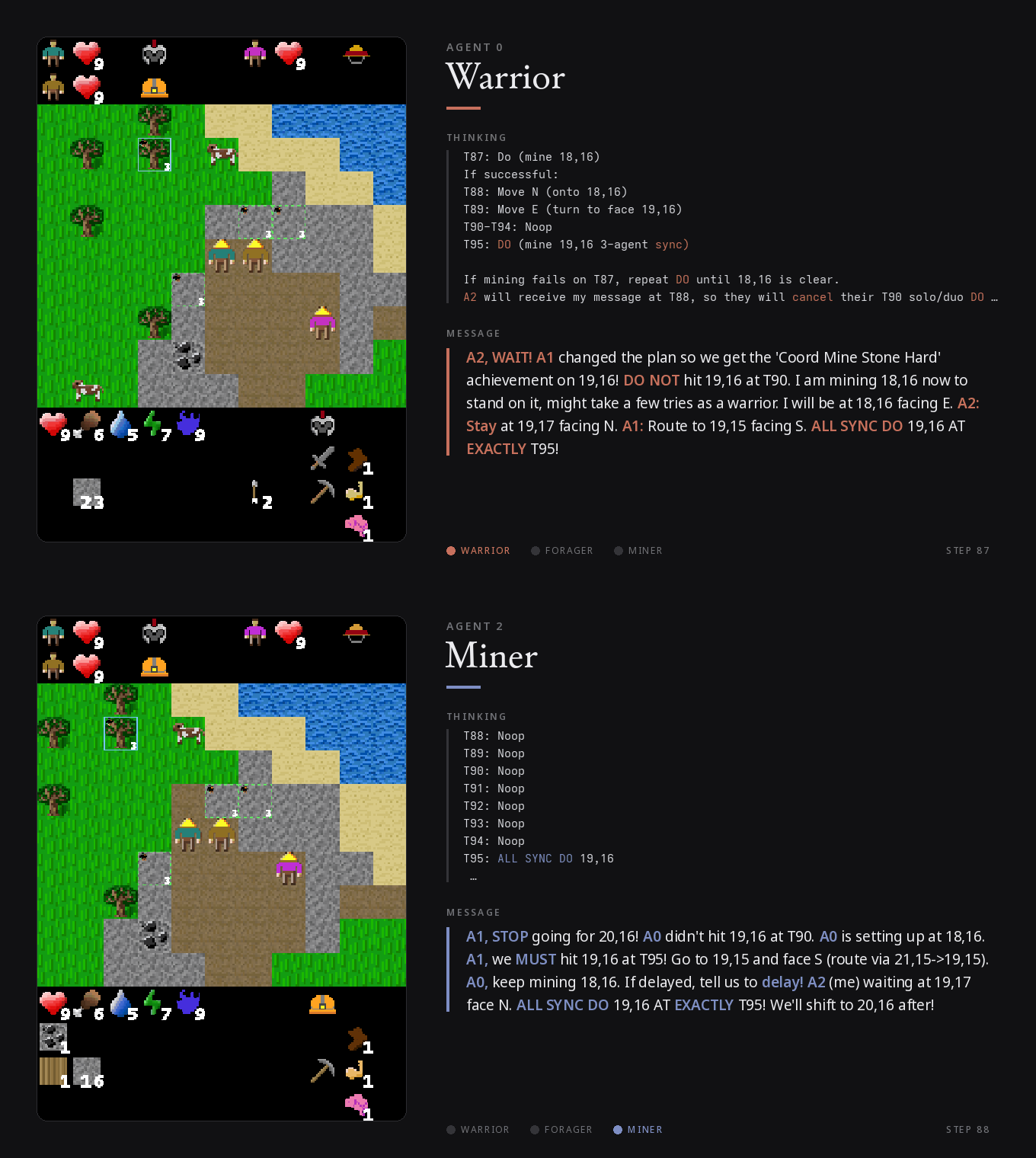
Trained MARL teams and zero-shot language agents tackle the same underlying open-ended world. Watch them split work, broadcast intent, and synchronize their actions, or play the full reel.
04 · Environment
One world, three interfaces, diverse coordination demands.
Alem isolates coordination by pairing a rich open-ended Craftax-style world with explicit synchronization, handover, specialization, and construction tasks.
What makes Alem different
Long horizon
Episodes last up to 10,000 steps across nine procedurally generated levels.
Open ended
Agents pursue a web of goals: collect, craft, explore, trade, fight, descend, and build.
Explicit coordination
Tasks require shared timing, resource transfer, role division, and multi-stage convergence.
Controllable difficulty
A single α parameter scales incentive misalignment and coordination pressure.
Three interfaces onto one world
Symbolic
For MARL agents
- 9,730-dimensional observation vector: local maps, inventory, teammate directions.
- 60 discrete actions with legal-action masks (~20 valid per step).
- IPPO, HyperMARL-IPPO, MAPPO and PQN-VDN baselines, trained end-to-end in JAX.
Pixel
For humans & vision agents
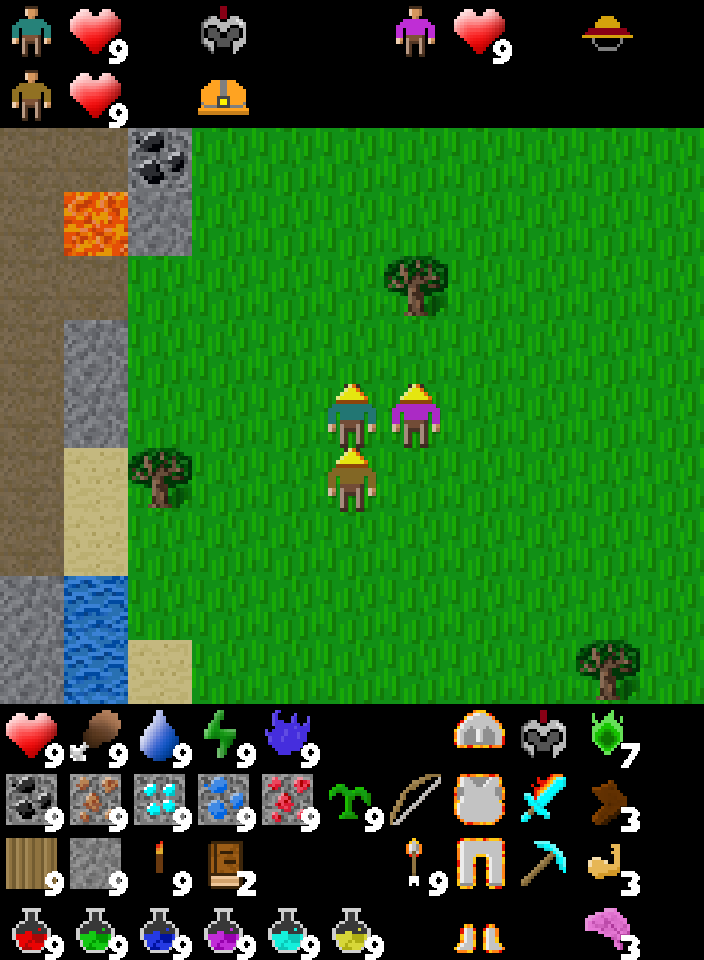
- An egocentric rendered view of the same world state, including map, HUD, inventory and teammates.
Text
For language agents
Step: 0/10000    Role: forager
Position: (x=25, y=24)
You see:
- tree 3 steps north (x=25, y=21)
- construction_site 1 step north
- water 5 steps east (x=30, y=24)

Available: Move North · Do · Rest ·
  Request Wood · Request Stone · ...

> <action>Move North</action>
> <communication>A1: I'll grab wood,
you mine the stone</communication>- Reason-then-act harness with scratchpad memory and broadcast messages.
View the full system prompt
Loading…Diverse coordination demands
Soft specialization
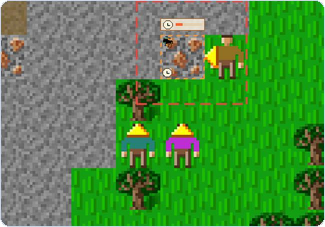
Any agent can act, but specialists are more effective; encourages division of labour across foraging, mining, and combat.
Handover
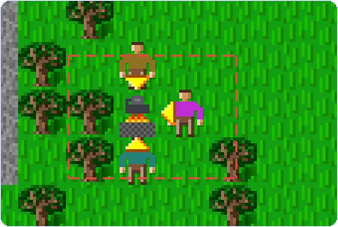
One agent begins, another completes within a time window; temporal slack makes it the most accessible.
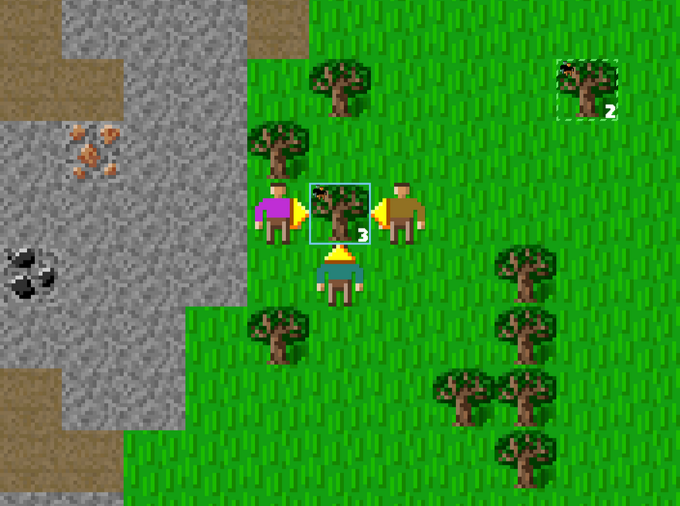
Synchronous
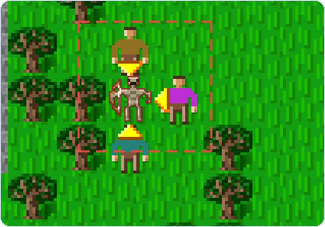
Agents converge on a shared target and act on the same timestep; the hardest demand.
Construction
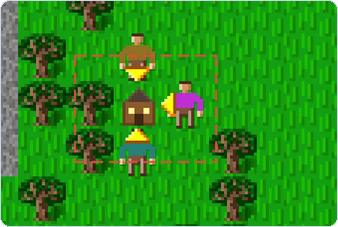
Gather resources, climb a tech chain, converge, and execute a multi-step build.
Scoring structure
Base66individual progress achievements derived from single-agent Craftax
Coordination27explicit multi-agent achievements
Total93normalised episode return, scored per category
05 · Paper results
What the benchmark reveals
13 LLMs in zero-shot three-agent teams, compared against trained MARL baselines. All comparisons use 95% bootstrap confidence intervals; Base%, Coord.% and Total% are normalised independently.
Current LLM agents remain far from solving Alem, averaging only ~6% normalised total return, yet their failures are not uniform.
Click any result to read the detail.
Q1.1 · zero-shotAlem is unsolved, but separates models
Alem remains far from saturated by both zero-shot LLMs and trained MARL, while separating models across a broad range. On Easy, Total% spans 0.8% (Llama-3.1-8B) to 18.1% (Gemini 3.1 Pro); on Hard, LLMs average only 6.2% Total%. The top LLM reaches 17.5% Coord.% on Hard difficulty, close to the 17.6% 1B-step MARL baseline.
Q1.2 · decompositionBase competence does not guarantee coordination
Decomposing performance reveals failures hidden by aggregate scores. GPT-5.4 achieves the second-highest Base% across difficulties, yet its Coord.% lags behind smaller models such as Gemma-4-26B-A4B on Hard, with non-overlapping 95% CIs. General environment competence does not guarantee coordinated multi-agent behaviour.
Q1.3 · difficultyMost LLM agents do not exploit the difficulty axis
Trained MARL degrades as coordination difficulty increases, but aggregate LLM Total% remains nearly flat at ≈6% across Easy, Medium, and Hard. Most LLM agents do not coordinate reliably enough for the difficulty parameter to strongly affect aggregate performance.
Q1.4 · task structureCoordination failures differ across task structure
Coordination is not a single axis. Handover tasks are comparatively more accessible because they allow temporal slack. Synchronous-Hard tasks require agents to identify a shared target, navigate to compatible positions, communicate intent, and act in the same timestep. Gemini 3.1 Pro leads LLMs here with only 18% coverage.
Q2 · ablationsCommunication is critical for coordination
Removing communication produces the largest drop in coordination for both models tested: Gemini 3.1 Pro falls from 17.5 to 5.3 Coord.%, and Gemma-4-31B from 8.8 to 3.8. Reasoning supports both base and coordination reward; scratchpad memory helps mainly when used to plan ahead.
Q3 · compositionHeterogeneous teams perform near the homogeneous-team average
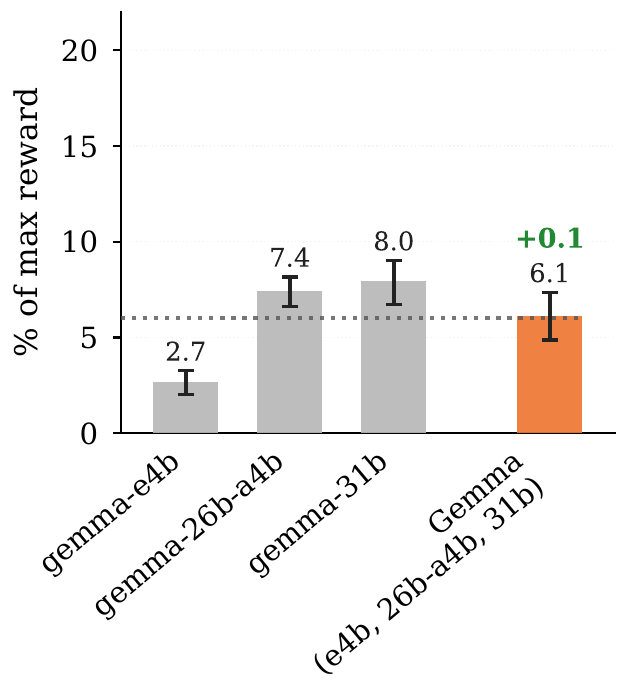
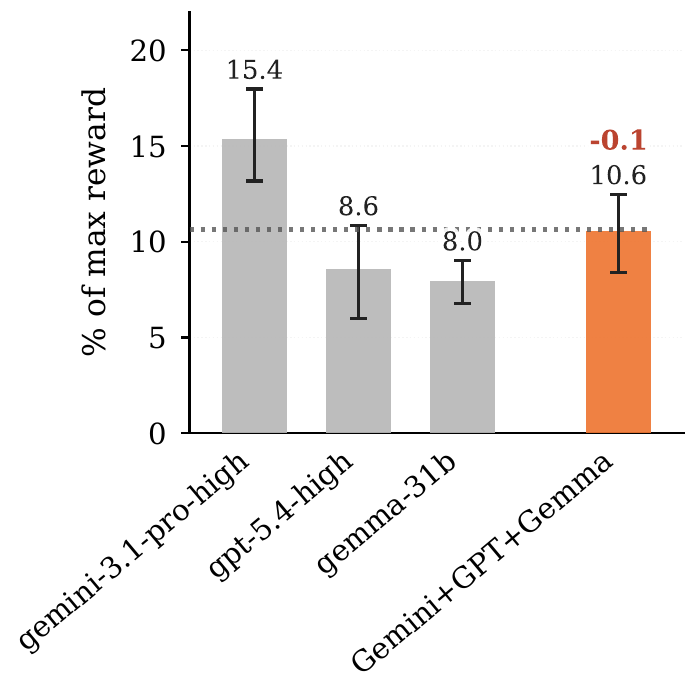
Mixed teams land close to the average of their corresponding homogeneous teams: the same-family Gemma team is slightly above (+0.1 Total%), the cross-family team slightly below (−0.1 Total%). Adding a stronger model is not sufficient to lift team performance.
Diagnostics
Click any plot to read the detail.
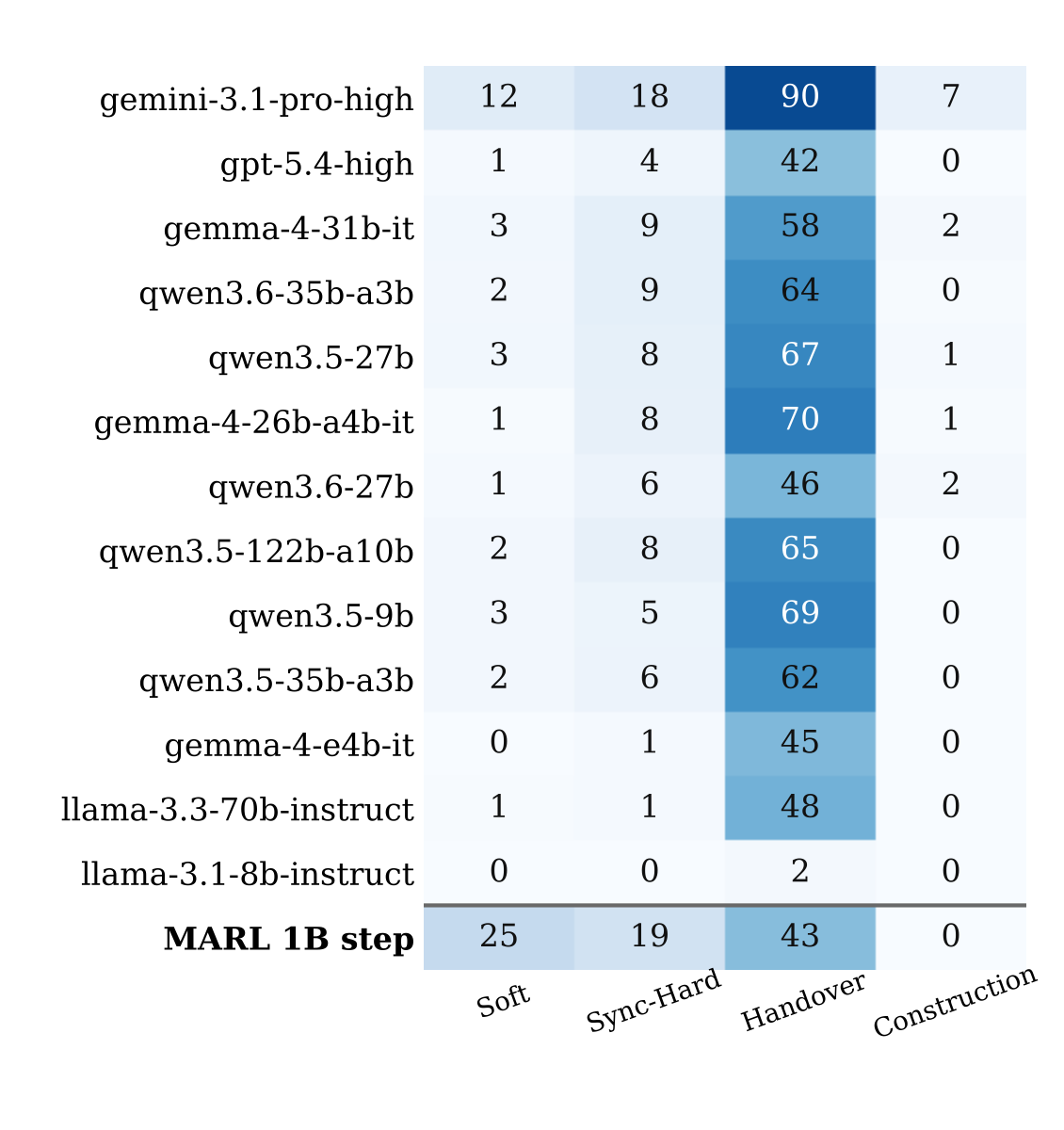 Coordination coverage by type.
Coordination is not a single axis. Handover tasks are comparatively more accessible because they allow temporal slack: one agent can initiate an opportunity and another complete it within a bounded time window. By contrast, Synchronous-Hard tasks require agents to identify a shared target, navigate to compatible positions, communicate intent, and act in the same timestep. Gemini 3.1 Pro leads LLMs on synchronous-hard coordination with only 18% coverage, while the next-best reach 9%.
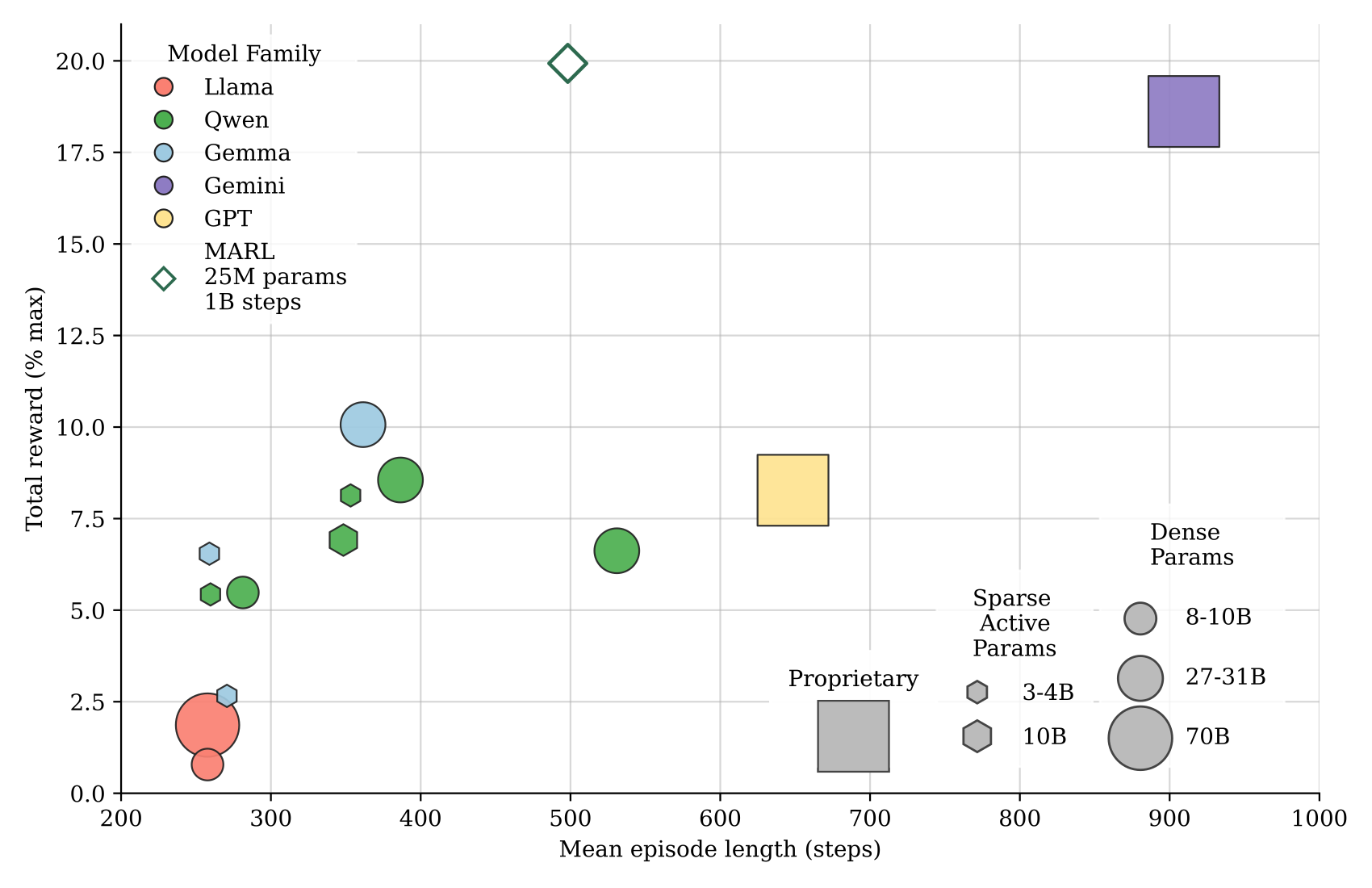 Survival vs reward.
Many models survive for long episodes despite low returns. Mean episode length versus Total% reward shows that longer survival does not necessarily translate into progression or coordinated achievements. This suggests the main bottleneck is not basic survival or interface parsing, but converting interaction time into coordinated progress.
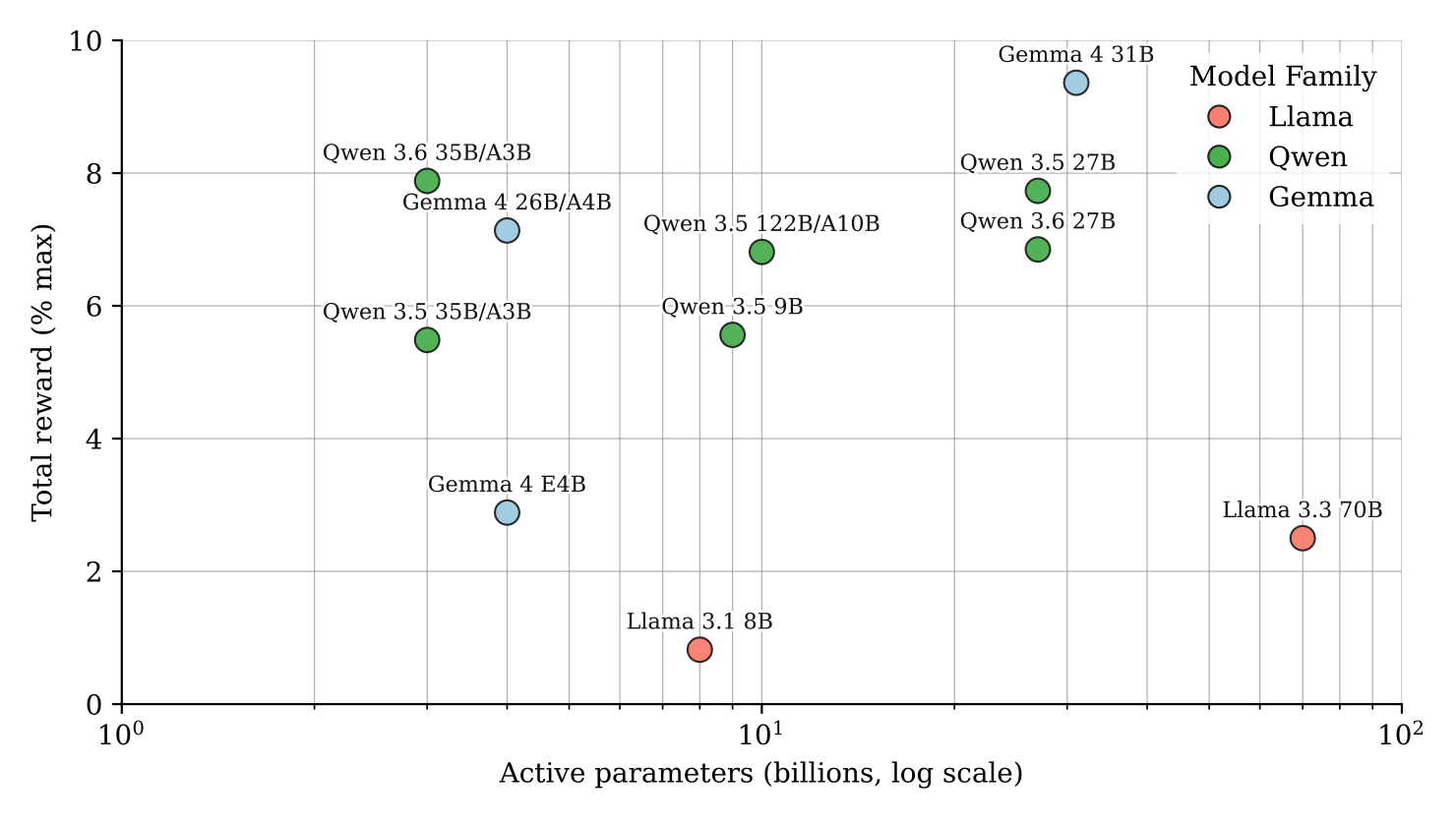 Scale vs performance.
Across open-weight models, performance is not monotonic in parameter count. Even within model families such as Gemma-4 and Qwen-3.5/3.6, coordination performance does not scale linearly across dense and mixture-of-experts variants. This suggests coordination depends on factors beyond raw scale, including post-training, reasoning, and how effectively agents use communication.
Harness ablations
Click either plot to read the detail.

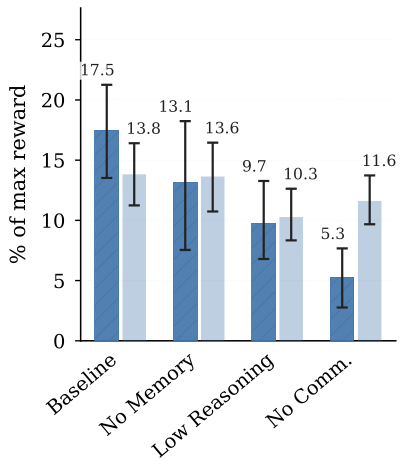 Gemini 3.1 Pro ablations.
For coordination, communication matters most, then reasoning, then memory. Removing communication produces the largest drop, from 17.5 to 5.3 Coord.%. Reasoning is the only ablation that lowers both Base% and Coord.%. Scratchpad memory helps mainly when used as a forward-looking planner.
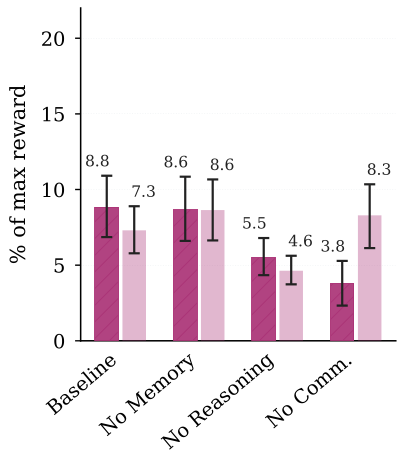 Gemma 4 31B ablations.
Gemma-4-31B shows the same ordering: removing communication is the largest drop, from 8.8 to 3.8 Coord.%. Without reasoning, Gemma writes longer scratchpads that partly substitute for it, but the compensation is incomplete, and both Base% and Coord.% still fall.
Heterogeneous teams (Hard)
Paper figure: mixed teams land close to the average of their homogeneous members.

Citation
@article{tessera2026alem,
  title   = {Benchmarking Open-Ended Multi-Agent Coordination in Language Agents},
  author  = {Tessera, {Kale-ab} Abebe and Szecsenyi, Andras and Barker, Cameron and
             Rutherford, Alexander and Paglieri, Davide and Scannell, Aidan and
             Gouk, Henry and Crowley, Elliot J. and Rockt\"{a}schel, Tim and
             Storkey, Amos},
  year    = {2026},
  url     = {https://arxiv.org/abs/2606.08340}
}